
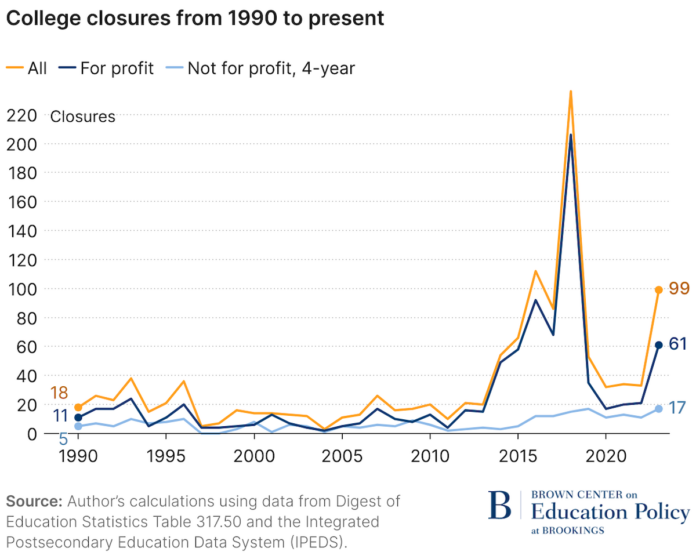
College closures get a lot of attention but they may be having an outsize impact on the psyche of higher ed. A new analysis of the so-called enrollment cliff finds most colleges are “at no risk of closing” but face a far more realistic threat.
Closures are surging but at a lower rate than in the more turbulent years just before the COVID pandemic, according to the Brookings Institution report. In 2018, 236 colleges closed compared to 32 in 2020 and 99 in 2023. For-profit institutions accounted for large majorities of the closures in all three of those years—for instance, 17 four-year nonprofits shut down last year.
Notably, the four-year nonprofits that closed in 2023 were “very small,” enrolling an average of 123 students. “Nationwide, ‘only’ a few thousand students were affected,” writes Dick Startz, the report’s author and a professor of economics at the University of California, Santa Barbara. “Since there are something like 11 million four-year college students, we’re talking about closures affecting fewer than one in a thousand students.”
More from UB: Promising start to this year’s FAFSA rollout. Can it hold on?
The colleges that closed were not only small but they had also experienced steady enrollment declines. In the coming years, institutions with low enrollment and small or non-existent endowments are most at risk of going under. Startz also advises that some states will see “drastic” enrollment declines but warns that the more realistic risk for most colleges and universities will be having to remove programs.
“There are many, many colleges that are quite small and not very selective and therefore at real risk from enrollment drops,” he notes. “The typical college in the United States is neither a football power nor a research factory. Half the colleges in the U.S. enroll fewer than 2,200 students. In fact, nearly a third of U.S. colleges enroll under 1,000 students. Some of these places are vulnerable.”
Program closures, which lead to layoffs and downsizing, have occurred at “some of the nation’s most successful universities,” Startz points out.
- The Pennsylvania State University’s regional campuses cut 10% of their staff to cope with a 20% enrollment drop—even though enrollment at its main campus is growing.
- West Virginia University, where enrollment has stagnated over the last five years, eliminated 28 programs and 147 faculty positions.
- Enrollment has dropped by 16% over the last 10 years at the University of Wisconsin-Milwaukee, which is shutting down its College of General Studies and laying off 32 tenured faculty.
“There’s no single narrative or overall trend that perfectly describes the future of college enrollment,” Startz concluded. “While college closures are hard for the students and employees of those institutions, it’s probably program eliminations within colleges that are likely to be the bigger story in the years to come.”