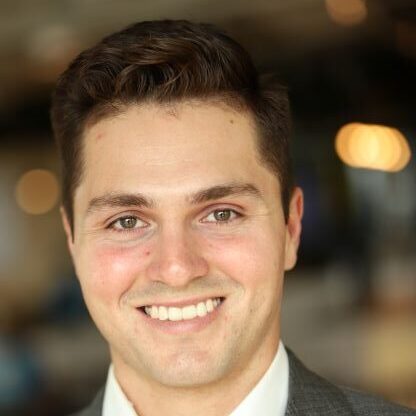
Two years into his tenure at Fairleigh Dickinson University, President Michael Avaltroni is building a statewide network that spans a learner’s journey from K12 to higher ed to the workplace.
Avaltroni is building a coalition of New Jersey higher education institutions and organizations to better integrate human and machine learning in healthcare. Fairleigh Dickinson University also recently signed a memorandum of understanding with Rowan University to expand the state’s supply of healthcare professionals.
Avaltroni intends to cement the four-year university’s relevance as the economy and student demographics shift.
“We’re focused on building the university of the future,” he says. “It will require our programs, pathways and campuses all working together.”
Fairleigh Dickinson has partnered with Rowan University to offer students dual-degree healthcare programs and accelerated academic pathways. Fairleigh Dickinson’s pre-med students can now access Rowan’s advanced degrees in osteopathic medicine, while Rowan’s students can join new programs in pharmacy, occupational therapy and public health.
More on academic innovation: Why these leaders link interdisciplinary learning to improved outcomes
“We think about the complementary rather than the competition of programming,” Avaltroni says. “We’re not aspiring to build our own medical school over the next decade, so we’d rather work with like-minded partners and contribute to one another’s mission.”
Fairleigh Dickinson’s blueprint for partnering with Rowan University:
Avaltroni works with several nearby K12 districts to steer high school graduates onto postsecondary healthcare pathways.
This web of two-year, pre-med and postgraduate students should eventually produce intergenerational living and learning communities, Avaltroni says.
Institutions can expand their on-campus cohorts of traditionally aged students with new residents of university-based retirement communities, which have grown in popularity over the last year.
“We believe we could become a real hub or epicenter of new ideas, innovation and delivery modes for healthcare,” Avaltroni says. “Most importantly, the living, learning and education that we’re committing to will deliver better health outcomes to the communities we’ve built.”